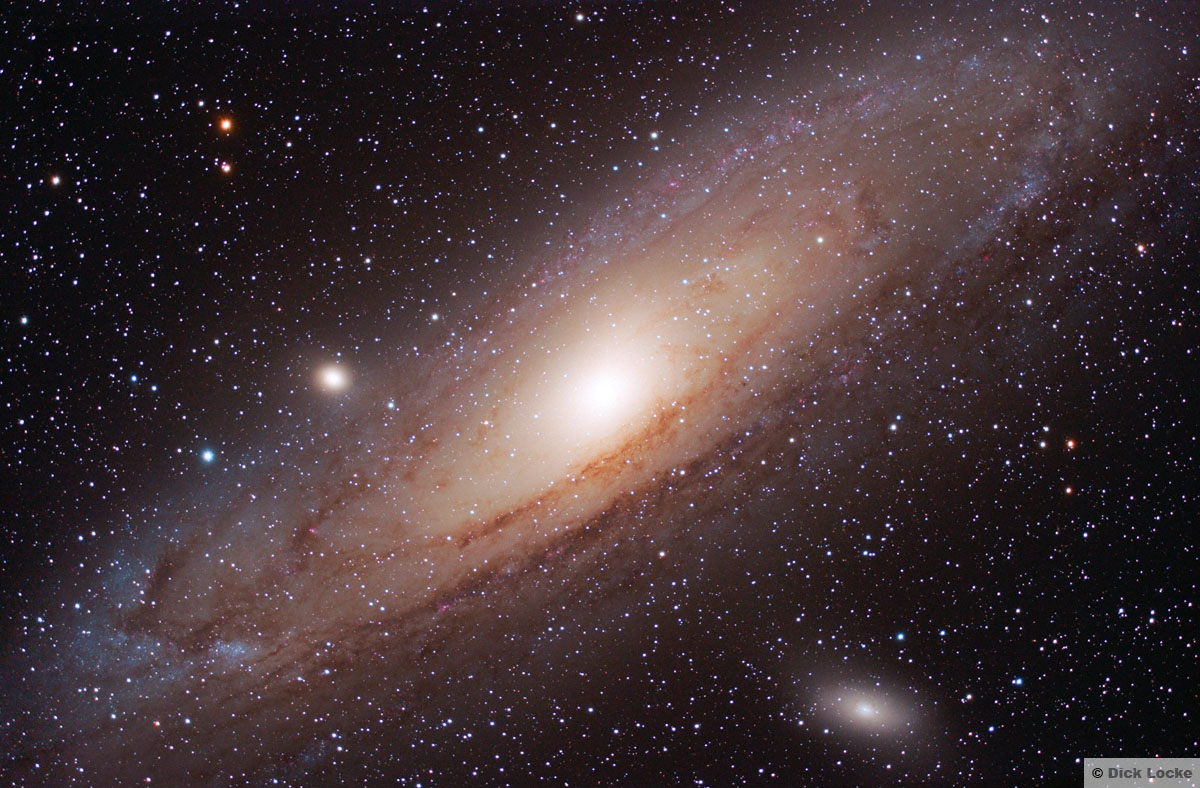
M31, The Andromeda Galaxy - Fall 2010 CCD View
Here's M31, the Andromeda Galaxy. This is the most distant
object we can see from earth "naked eye." The small red areas are caused
by the deep red wavelengths of light given off by the
 Bright
Nebula in the
neighboring galaxy.
Bright
Nebula in the
neighboring galaxy.
See this
Wikipedia link for more info on M31. More: The Andromeda galaxy can be seen as a hazy patch with the naked eye from a dark site. Therefore, it is the most distant object you are likely to see with the unaided eye. It is easily visible with binoculars. In fact, it is too large to fit into the largest field of view of many telescopes, so it is best appreciated with binoculars.
Notes: The image above is from the Fall 2010 Davis Mountains trip, 34*5 minute = 170 minutes total exposure. I was hoping for more exposure time but the weather didn't cooperate and I had to discard a lot of images. The quality minutes I do have, though, come from the famously dark west Texas skies. The Takahashi TOA 130 (a 5" APO refractor) with reducer, and Astro-Physics AP 900GTO mount, QHY8 CCD Camera & normal workflow. December 2010 from the Davis Mountains.
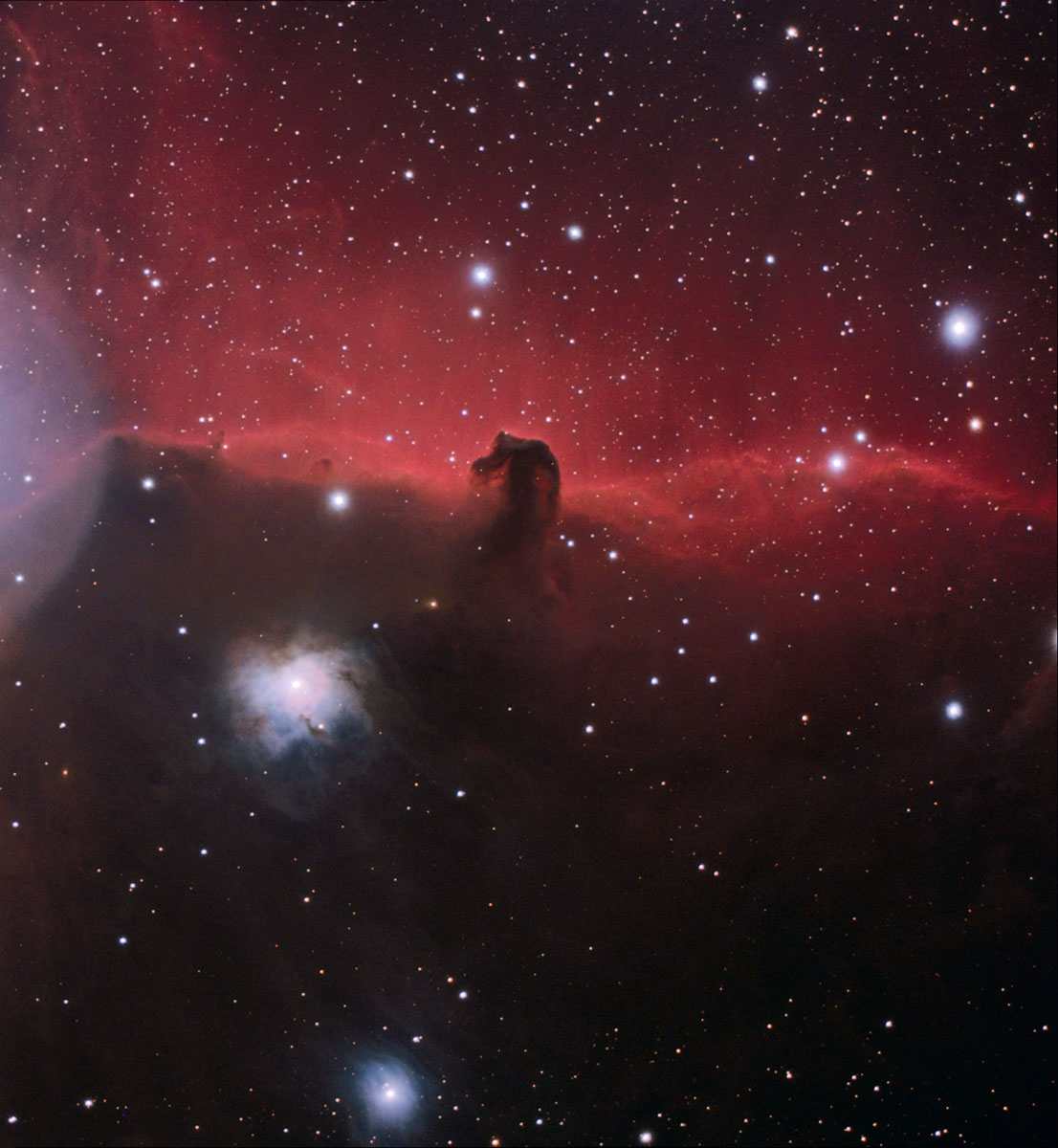
Horsehead Nebula PortraitThis is a blend of 130 frames, with the most recent 41 coming from The Davis Mountains December 2010 trip. There's about 12 hours total exposure involved. This is an area filled with interesting objects and I'll continue to work on this area in the future, especially with narrowband filters from the back yard. Takahashi TOA 130 Telescope (a 5" APO refractor telescope) with the reducer, AP 900GTO mount, QHY8 CCD Camera. Other pictures from the camera are are here. Images processed using my Astronomy Image Processing Workflow.
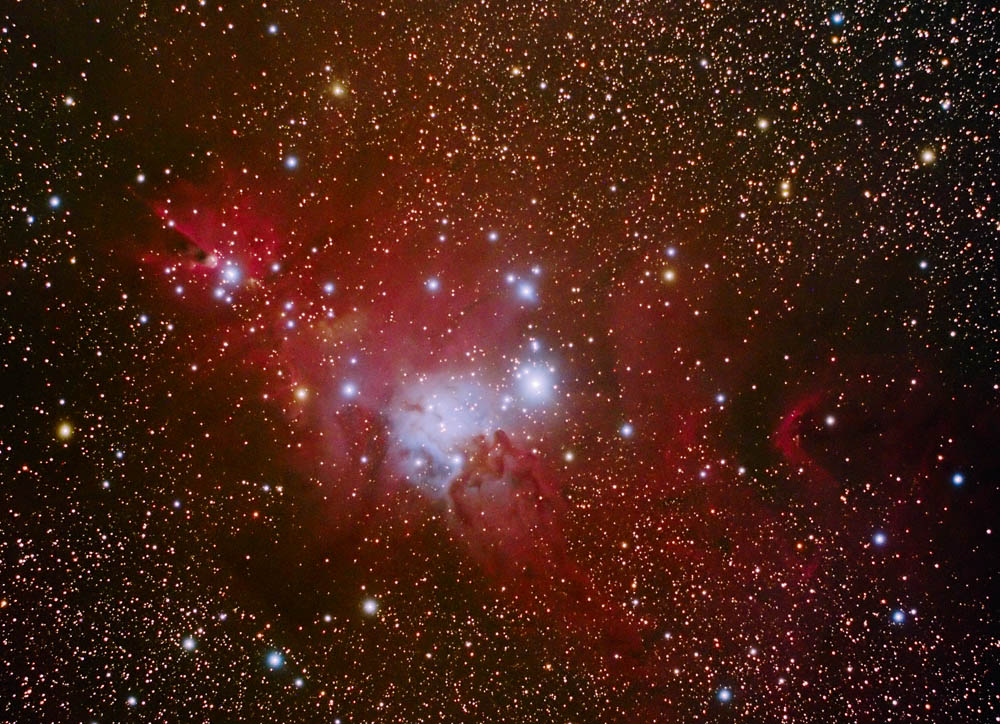
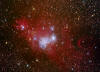
Christmas Tree Cluster & Cone Nebula AreaThe Christmas Tree Cluster is NGC 2264. The "cone" part is on the left part of the image, just below center. This includes the "Fox Fur Nebula".
IC 2169 is in the area.Above Image: 16 * 5 min = 80 minutes total exposures. Takahashi TOA 130 Telescope (a 5" APO refractor telescope) with the flattener, AP 900GTO mount, QHY8 CCD Camera. Other pictures from the camera are are here. Images processed using my Astronomy Image Processing Workflow. Compare with my older DSLR image below.
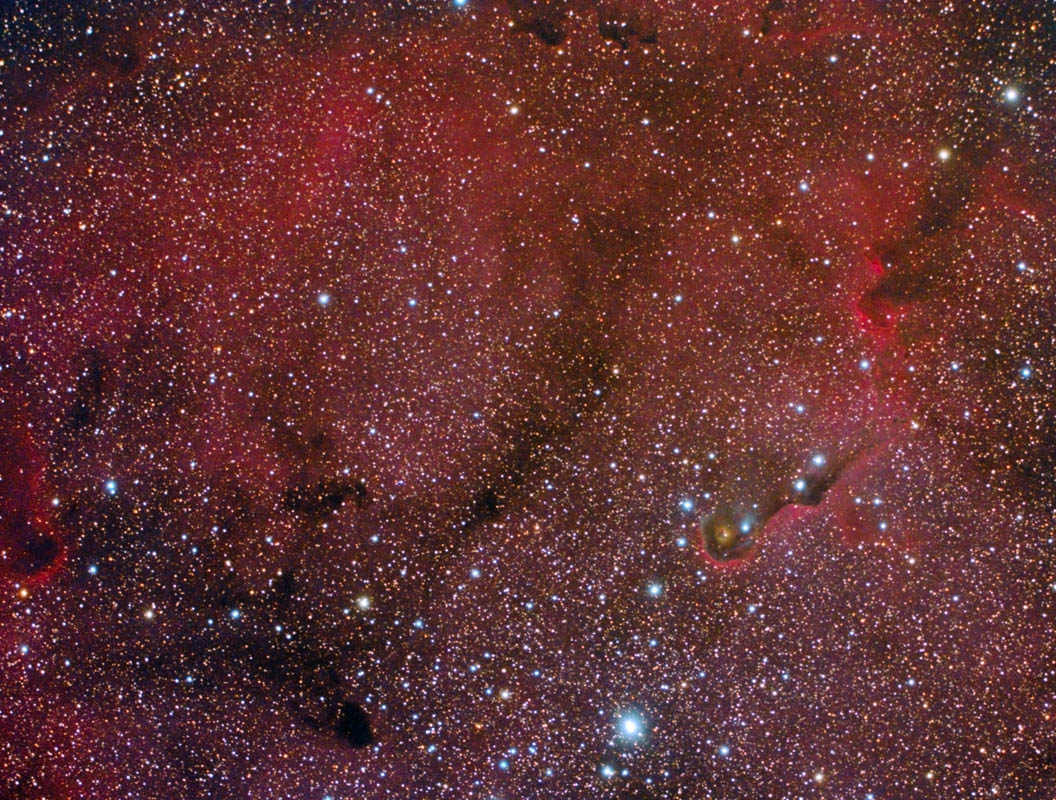
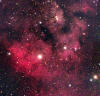
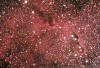
IC 1396 Area CCD ImageThis is a star forming area around 3000 light years from Earth. Note the dark dust clouds. Dark Nebula Barnard 161 (B161) is on the mid-lower left, along with LDN 1110, 1112, 1124, 1121, 1117, and several more. Image composed of 18 * 4 = 72 minutes exposure using Takahashi TOA 130 Telescope (a 5" APO refractor telescope) with the reducer, AP 900GTO mount, QHY8 CCD Camera. Other pictures from the camera are are here. Images processed using my Astronomy Image Processing Workflow. Compare with my older DSLR image later on this page.
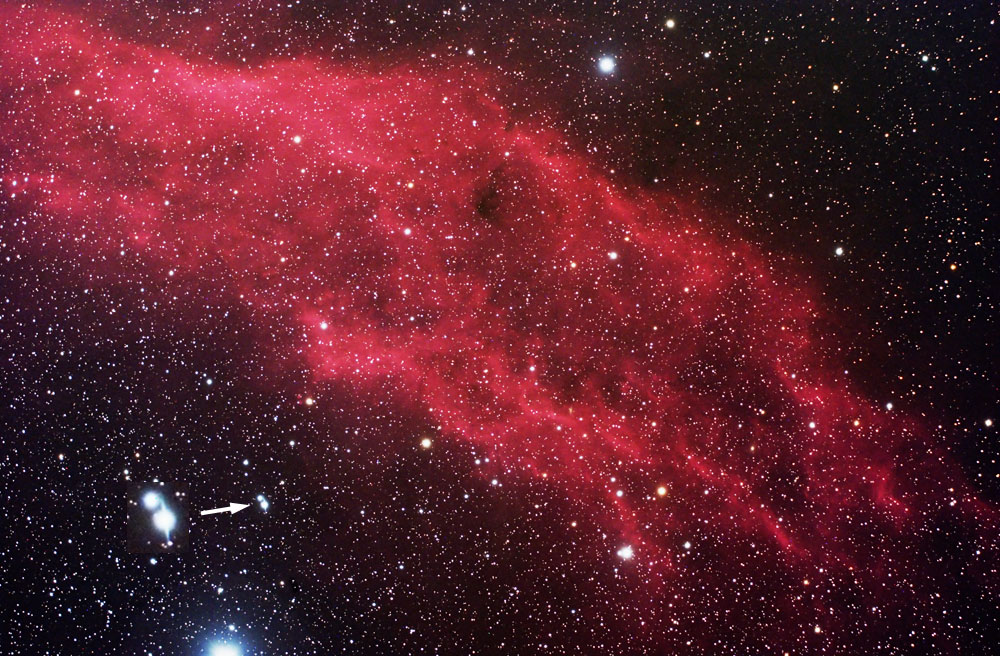
Above image taken with my usual setup and processed the usual way, notably with the Takahashi TOA 130 Telescope & reducer, and the QHY8 CCD camera. This is from Wimberley, TX, 12/2009, 18x5 minutes = 90 minutes in mediocre sky conditions, right before things completely fogged in.
Note the inset in the lower left, which is interesting. The one star, which I believe is identified below, ended up with a spike. It looks like "blooming" I believe, but I've never seen the camera do that. Let me know if you have an idea as to what caused that please!
Object name: SAO 56870
Other ID: GSC 2369:1598
Magnitude: 8.55
Equatorial: RA: 04h 00m 34.53s Dec: +36°02'49.06"(current)
Equatorial 2000: RA: 03h 59m 52.83s Dec: +36°00'57.28"
CCD and DSLR astrophotography comparison: Here are some pages showing the same objects shot with the QHY8 CCD Camera vs. Canon EOS 20Da DSLR camera.
|
|
|
|
|
|
Pictures from the first "night out" with this camera are below.
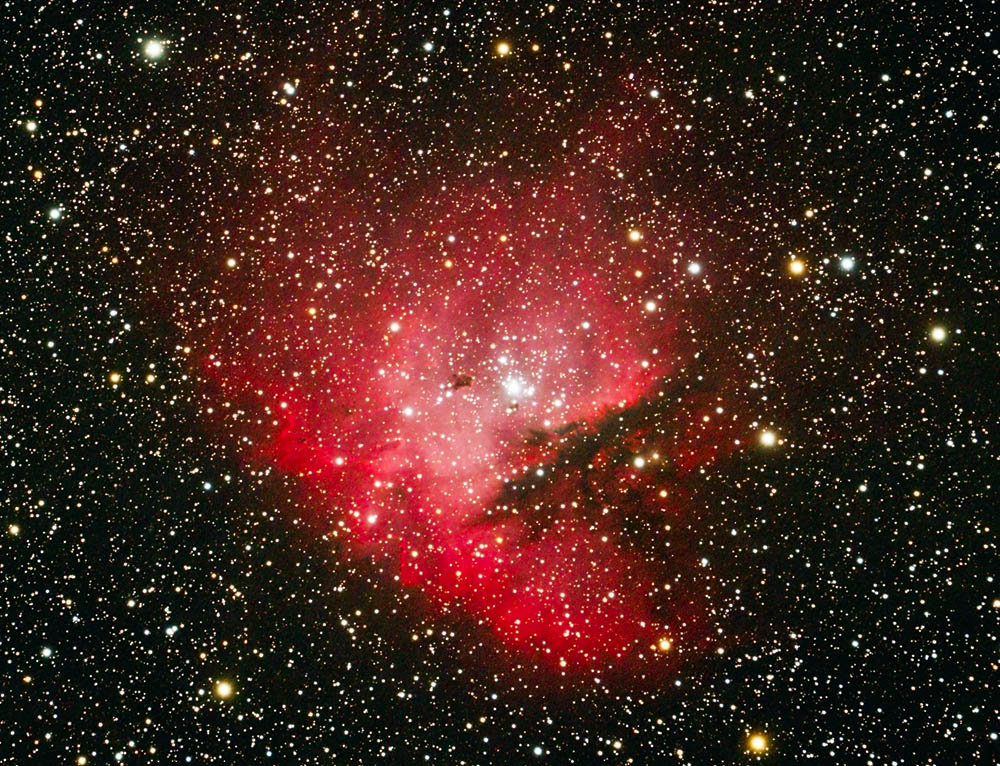
Three hours (36x5 minute) exposures using the QHY8 CCD camera. Details on this nebula are found on my primary Pacman nebula page here. Telescope was the Takahashi TOA 130 with the flattener with the AP 900GTO mount and the QHY8 CCD Camera. 9/27/2008, HAS Site near Columbus, TX. Image Processing: I intended to shoot raw but did not. Processed in nebulosity with 20 flats (not bias subtracted) and 6 darks (not bias subtracted). Combined in Registar, a little stretching in Nebulosity, and final processing in Photoshop CS3. Neat Image noise reduction.

B86, the dark nebula, is also known as "The Ink Spot." NGC6520 is the open cluster. Image data: 8x5 min exposures with the new camera, and my first attempt at processing fits files. 9/27/2008, HAS Site near Columbus, TX.
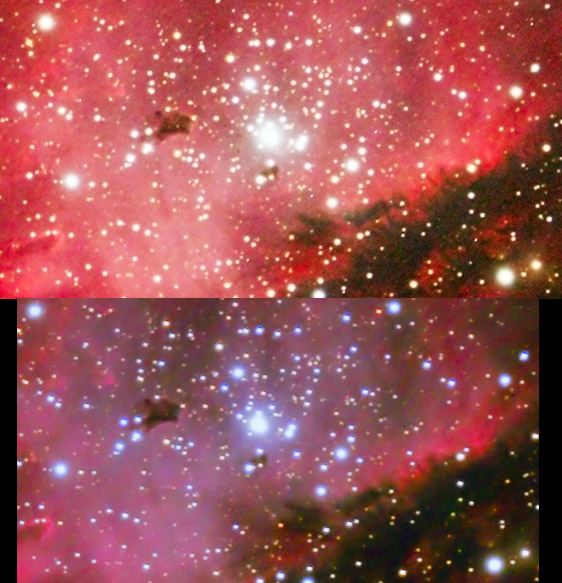
QHY8 CCD Camera (top) and Canon 20Da Comparison
180 minutes exposure on top, vs. 84 minutes. Obviously the DSLR shot was processed more to accentuate the blue. Whether the blue is "natural", a result of poor focus or artifacts, or that was just the way I processed it is not clear. The other web images I've checked out don't have the blue. Beyond all that, I would observe:
The total exposure is much longer on the CCD camera, due in part to the fact that it's cooled and I didn't need to worry about taking dark frames during the imaging session. In other words, I can spend full time shooting targets with the CCD.
Overall focus and star quality is higher with the CCD.
More stars are visible in the CCD image. I has more information and is sharper. Most noticeably, the star in the dark area (Bok globule) on the left is clearly visible in the CCD image, verses just hinted at in the DSLR shot.
The dim nebulosity on the lower right is much more visible in the CCD image. The detail in the dark nebula there is much higher. Generally it is much easier to preserve very dim detail in objects, with acceptable noise, with the CCD.
Artistically, I do like the blue 8-)
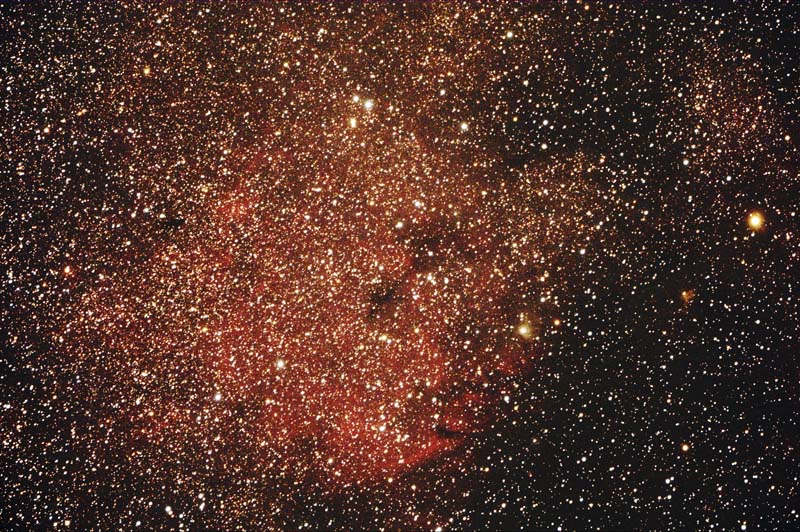
This picture of IC4701 deserves more than the 4x5 min exposure from Sept 27, 2008. IC 4701 gets overlooked, I'm sure, because it is in the same neighborhood as a number of very bright objects (M16 (pillars of creation area), M17 (Swan/Omega Nebula), and M18). Thanks to Ed K. for identifying it. (My notes had it as NGC 6618, which is M17...)