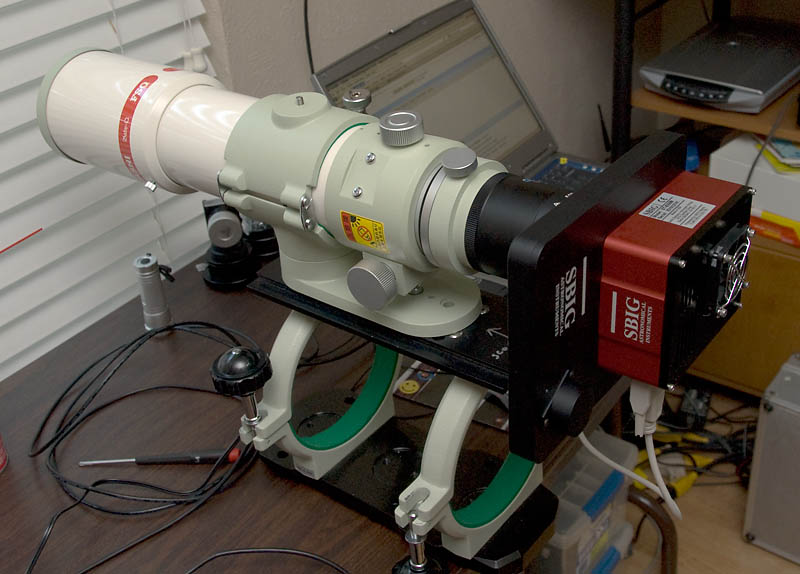
SBIG ST-8300, FW8-8300, and the Takahashi FSQ-85
The small 5.4 micron pixels make the ST-8300 a good match for the short focal length "Baby Q" refractor. Here is where I feature narrowband images from this camera. See my astrophoto processing page for details on software used to capture and process images.
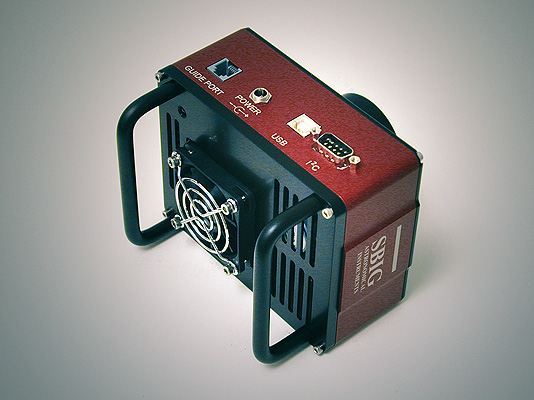
Picture of ST-8300 from SBIG's Web Site
Fastest possible shutter speed is very close to 0.1 seconds. Unfortunately, that's too slow for the EL panel I use as a light source through a clear filter on my f5 Tak FSQ-85. Attenuating the light source with ~4 pieces of white paper is my work-around.
My FW8-8300 Filter wheel (this is a new model as of early 2011) control is to be supported in a v206 release of CCDSoft (it is not supported in the March 2011 production version of CCDSoft). After registering CCDSoft I was able to download the "daily build." I confirmed selecting the FW8-STL is possible in v206 and I also confirmed that this selection seems to manage the filters properly. I also upgraded to the latest production version of Nebulosity and confirmed it allows control of the filter wheel. Maxim Dl supports the filter wheel in a production release as of 2011. I'm using Astrodon 36mm 5nm filters in the FW8-8300.
Check this link for the First Light ST-8300 with FSQ-85 Picture
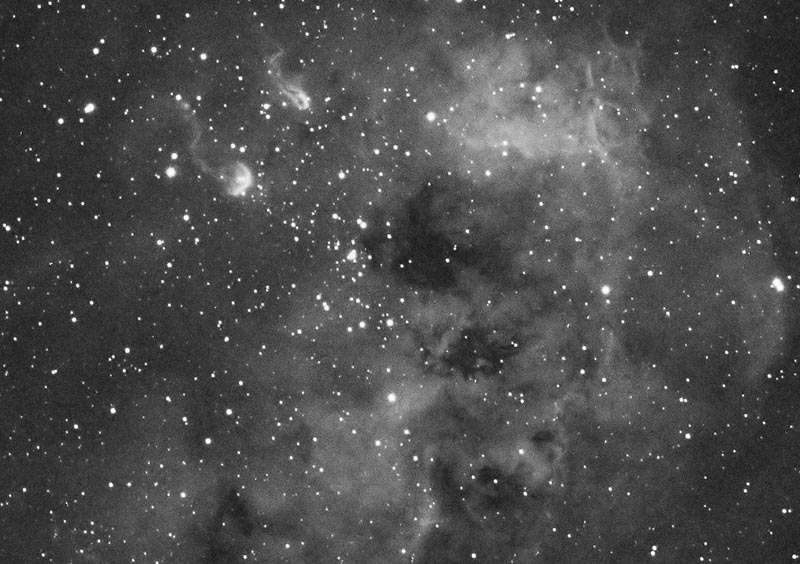
Captured from my back yard: 8 frames exposed for 2 minutes each with a H-alpha filter. I hand selected these frames as I wasn't autoguiding when I took the new camera on a shakedown cruise. TOA 130 telescope with reducer. See my IC410 Page for more on the tadpoles and a full-color view.
I'm migrating to this monochrome SBIG astronomical camera from my "one shot color" (OSC) QHY8 camera. There are 3 new improvements with this over my previous cameras:
Monochrome sensor, allowing use of narrowband filters that enable good quality imaging from suburban sites. It is possible to get good narrowband results with a color camera, but at the cost of 3-4 times the exposure needed on the monochrome camera. See more info on narrowband filtering with this camera at the bottom of my Narrowband Imaging page.
Regulated cooling makes it much easier to post-process images with excellent results. The fixed temperature allows a "library" of dark, flat, and bias frames to be build based on same-temperature noise behavior. More info about Processing Astrophotos is here.
Smaller pixels to better match wide-field telescopes & camera lenses
With a monochrome camera you can use Red/Green/Blue/Clear filters to create regular color images, but you can also use special narrowband filters to create false color images such as those you see from the Hubble telescope. Narrowband filters do not work well on OSC and DSLR cameras as they cause 75% of the light to be blocked due to the bayer filter that produces color (true for the important H-alpha and other deep red color wavelengths, at least). Narrowband filtering for astronomy is covered at this Starzonia link.
Narrowband (NB) filters enhance contrast of emission objects by accepting only a narrow range of wavelengths around the emission lines of hydrogen (H-a, 656 nm), oxygen (OIII, 501 nm), sulfur (SII, 672nm). I'm using Astrodon 36mm 5nm filters in the FW8-8300.
ST-8300 Specifications: The camera is listed at 1.8 lbs, the filter wheel at 1.8 lbs also making the total weight around 3.6 or call it 4 lbs.
CCD | |
| CCD | Kodak KAF-8300 |
|---|---|
| Pixel Array | 3326 x 2504 pixels |
| CCD Size | 17.96 x 13.52 mm |
| Total Pixels | 8.3 million |
| Pixel Size | 5.4 x 5.4 microns square |
| Full Well Capacity | ~25,500 e- |
| Dark Current | ~0.02e-/pixel/sec at -15C. |
| Antiblooming | 1000X |
Readout Specifications | |
| Shutter | Mechanical, Even-illumination |
|---|---|
| Exposure | 0.1 to 3600 seconds, 10ms resolution |
| Correlated Double Sampling | Yes |
| A/D Converter | 16 bits |
| A/D Gain | 0.37e-/ADU |
| Read Noise | ~9.3e- rms |
| Binning Modes | 1 x 1, 2 x 2, 3 x 3, 9x 9, 1 x n |
| Pixel Digitization Rate | > 1 million pixels per second |
| Full Frame Download | ~7.5 seconds |
| Focus Mode | ~1 second |
System Specifications | |
|---|---|
| Cooling - standard | Single Stage Thermoelectric, Active Fan, max delta -40C, -35C regulated at ~80% power |
| Temperature Regulation | ±0.1°C |
| Power | 12VDC at 3 amps, universal power supply included |
| Computer Interface | USB 2.0 |
First Light Notes Jan 2010: Most things were smooth through first-light with the new camera and CCDOPS software. However the camera did act up while focusing, a shutter issue I think. This was the first time I'd ran the shutter and maybe something wasn't quite set. It may also have been a driver issue according to SBIG. Since the first night I've tested quite a bit and the issue seems to have resolved, and I just downloaded the latest drivers.
February Update: No good, the shutter does not work properly at cold temperatures. It's fine at room temp, go figure. It's on its way back to SBIG for repairs! Here come the clear skies no doubt.
March Update: SBIG diagnosed the problem as a bad solder associated with the shutter motor... I have the camera back now (Spring 2011) and here are the first light images with the repaired camera.
SB-FW8-8300 SBIG
FW8-8300 - 8-Position 36mm Filter Wheel for ST-8300 & ST-4000 Cameras
Here was the problem I had as posted 8/20/2012 to the SBIG Yahoo Group
This weekend I finally hooked up my Nikon 50mm lens to my FW8-8300 & ST-8300M camera using a SBIG lens adapter purchased from OPT (part CLA-8300N, see link below). I was hoping to compare image quality on several lenses with some test patters. I was not able to bring the lens to focus from a distance of around 3 to 36 feet in the limited testing I was able to do. It looks like I needed a greater distance to achieve focus -- haven't been able to try to focus on stars yet.
The indoor result seems to mean the lens is too close to the sensor by a fair amount, which is surprising since I'm using a dedicated adapter for Nikon. Now I notice the part is discontinued by SBIG per OPT, which leads me to ask "why?" Is there a problem with the adapter and that's why it's discontinued? I
Has anyone successfully used this adapter, FW, and camera on a similar Nikon lens?
http://www.optcorp.com/product.aspx?pid=14543&kw=sb-cla&st=3
Thanks in advance for help/information on this.
Saturday night the wind forecast was so bad I decided to not bother imaging through telescopes. Instead I broke out the SBIG Nikon lens adapter and attached it to the SBIG 8300m. This involves changing out faceplates that connect to the camera. They’re held together by 4 screws, so it’s a bit of a deal but not too bad. I had problems with achieving focus with another lens via this arrangement in indoor testing, so was wondering what would happen in a real world astronomy test…
As might be expected, it didn’t work at night either. I was able to determine that the lens was too far away from the camera. It was cloudy in the early evening and very windy (20-30mph) when I was testing so this was a good time to debug. I brought everything inside and searched the internet for an actual picture of the setup I was trying to achieve. No luck.
I was able to determine that the camera adapter was two pieces, the plate and camera connector itself. The way the plate and connector were fastened together they stuck out a bit from the camera; my theory was if they could be switched it was logical that could fix the focus issue.
The two parts in question were connected by very small allen screws. Digging through the tool kit I thought it was a good omen when the first wrench I found fit perfectly. It was encouraging that everything went together the other way, and I was pleased to find out the after the change focus was achieved easily!
So the question is, did I put it together wrong, or did it come that way? Not sure right now ;-)